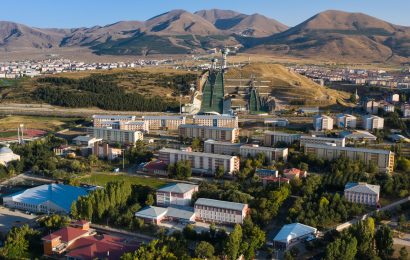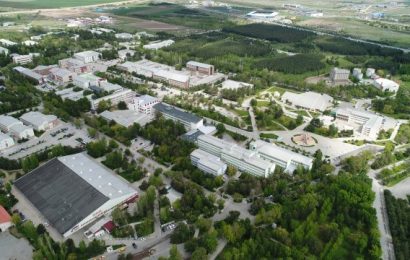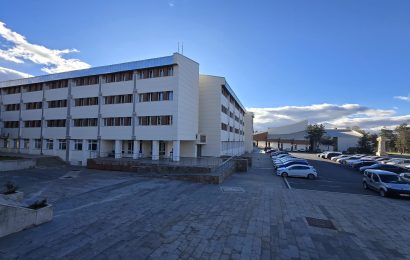
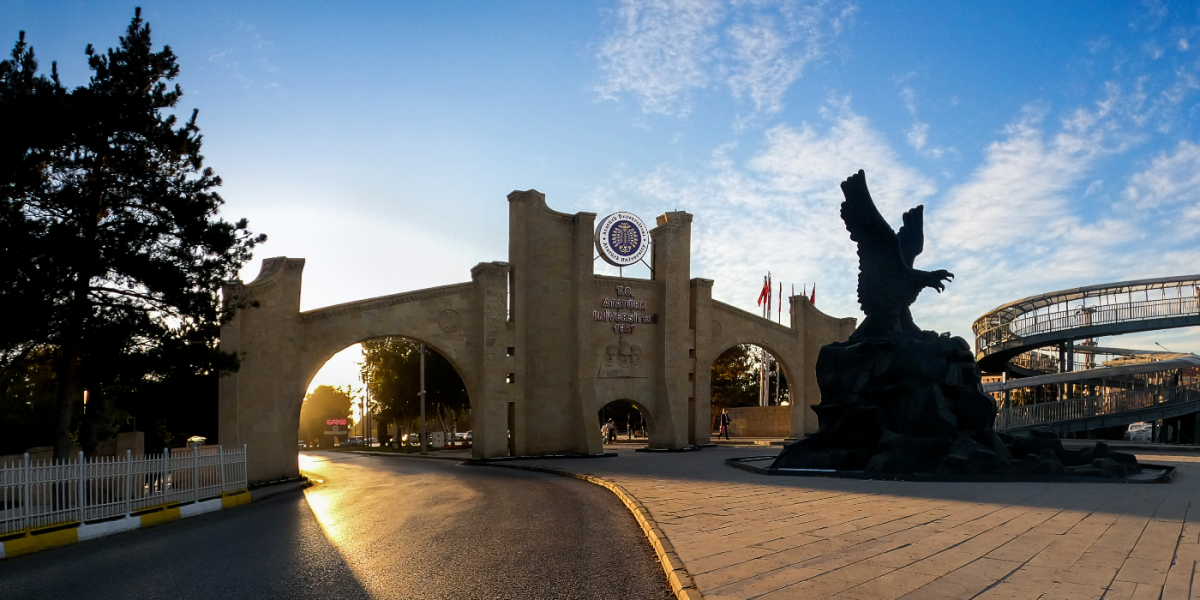
Atatürk University maintains a strong institutional commitment to gender equity in higher education access. In alignment with national and international frameworks, the university systematically tracks and analyzes women’s application, admission, and enrollment rates across all faculties and programs. This approach ensures that gender equality is not only a principle but also a measurable outcome within institutional performance monitoring.
Institutional Data Infrastructure & Reporting
All gender-related student statistics are centrally collected through the İstatistik AtaUni Portal, which publishes disaggregated data by gender on applications, admissions, and active enrollments.
👉 İstatistik AtaUni Portal
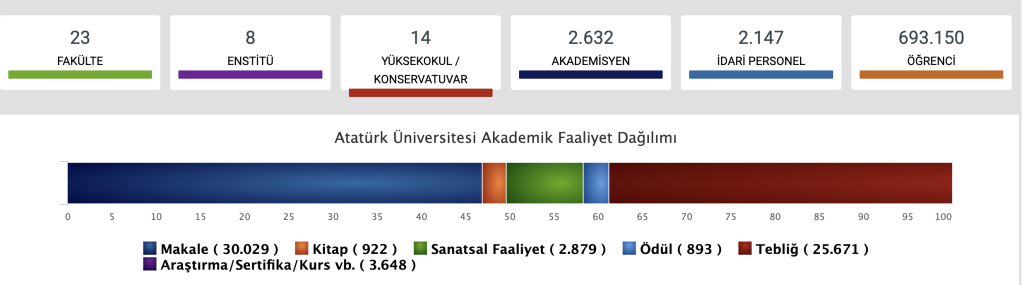
In addition, Atatürk University’s Annual Quality Report (YÖKAK 2024) includes gender-based analyses of student demographics and faculty composition. These data help the Rectorate, Senate, and Gender Equality Commission identify trends and areas requiring targeted support.
👉 YÖKAK 2024 Report
Systematic Measurement Framework
-
Application Stage: Gender information is recorded during the national university placement system (ÖSYM) process, enabling the calculation of women’s application rates across programs.
-
Acceptance Stage: Admission data are monitored to evaluate the ratio of female applicants receiving placement offers.
-
Enrollment Stage: Registration data allow calculation of final entry rates for female students at the beginning of each academic year.
-
Trend Reports: Yearly comparisons are published internally for Senate review to ensure steady or increasing female representation in all fields, particularly STEM.
Supportive National Policy for Women Over 35
Following the 2024 policy directive by the Council of Higher Education (YÖK), Turkish universities, including Atatürk University, began implementing special admission pathways for women aged 35 and above who wish to continue or resume their higher education.
Atatürk University monitors and reports these applications and admissions separately to ensure transparent tracking of mature female participation. This policy directly supports lifelong learning and gender inclusivity by addressing historical barriers that limited women’s educational access in later life.
In 2024, Atatürk University admitted over 240 women aged 35+ across open education and face-to-face undergraduate programs, a significant increase compared to 2023. These figures are included in the institution’s annual monitoring dashboard, further reflecting the commitment to equitable access and opportunity.

Table 1. Student Distribution by Gender and Academic Unit – Atatürk University (2024)
| No | Academic Unit | Female Students | Male Students | Total Students |
|---|---|---|---|---|
| 2 | Open Education Faculty | 4 | 47 | 51 |
| 3 | Justice Vocational School | 75 | 104 | 179 |
| 4 | Aşkale Vocational School | 502 | 444 | 946 |
| 5 | Institute of Atatürk’s Principles and History of Reforms | 17 | 30 | 47 |
| 6 | Faculty of Dentistry | 555 | 397 | 952 |
| 7 | Faculty of Pharmacy | 445 | 218 | 663 |
| 8 | Faculty of Letters | 3,558 | 2,416 | 5,974 |
| 9 | Institute of Educational Sciences | 853 | 555 | 1,408 |
| 10 | Erzurum Health Services Vocational School | 1 | 0 | 1 |
| 11 | Institute of Science | 1,134 | 1,338 | 2,472 |
| 12 | Faculty of Science | 799 | 541 | 1,340 |
| 13 | Institute of Fine Arts | 238 | 214 | 452 |
| 14 | Faculty of Fine Arts | 653 | 417 | 1,070 |
| 15 | Faculty of Nursing | 1,129 | 409 | 1,538 |
| 16 | Hınıs Vocational School | 431 | 168 | 599 |
| 17 | Horasan Vocational School | 364 | 637 | 1,001 |
| 18 | Faculty of Law | 669 | 531 | 1,200 |
| 19 | Faculty of Economics and Administrative Sciences | 1,505 | 1,845 | 3,350 |
| 20 | Faculty of Theology | 1,456 | 868 | 2,324 |
| 21 | Faculty of Communication | 948 | 1,254 | 2,202 |
| 22 | İspir Hamza Polat Vocational School | 347 | 645 | 992 |
| 23 | Kazım Karabekir Faculty of Education | 2,650 | 1,222 | 3,872 |
| 24 | Institute of Winter Sports and Sports Sciences | 103 | 225 | 328 |
| 25 | Faculty of Architecture and Design | 731 | 524 | 1,255 |
| 26 | Faculty of Engineering | 1,129 | 2,544 | 3,673 |
| 27 | Narman Vocational School | 354 | 378 | 732 |
| 28 | Oltu Faculty of Humanities and Social Sciences | 547 | 287 | 834 |
| 29 | Oltu Vocational School | 512 | 585 | 1,097 |
| 30 | Oltu Faculty of Earth Sciences | 0 | 1 | 1 |
| 31 | Pasinler Vocational School | 270 | 437 | 707 |
| 32 | Institute of Health Sciences | 960 | 522 | 1,482 |
| 33 | Faculty of Health Sciences | 1,012 | 63 | 1,075 |
| 34 | Vocational School of Health Services | 1,985 | 1,101 | 3,086 |
| 35 | Institute of Social Sciences | 1,750 | 1,933 | 3,683 |
| 36 | Vocational School of Social Sciences | 1,115 | 1,377 | 2,492 |
| 37 | Faculty of Sports Sciences | 296 | 753 | 1,049 |
| 38 | Faculty of Fisheries | 54 | 102 | 156 |
| 39 | Vocational School of Technical Sciences | 812 | 2,088 | 2,900 |
| 40 | Faculty of Medicine | 1,113 | 1,088 | 2,201 |
| 41 | Tortum Vocational School | 124 | 152 | 276 |
| 42 | Faculty of Tourism | 775 | 580 | 1,355 |
| 43 | School of Tourism Management and Hospitality | 0 | 1 | 1 |
| 44 | State Conservatory of Turkish Music | 84 | 103 | 187 |
| 45 | Institute of Turkic Studies | 352 | 182 | 534 |
| 46 | Faculty of Applied Sciences (Oltu) | 181 | 276 | 457 |
| 47 | Faculty of Veterinary Medicine | 276 | 305 | 581 |
| 48 | School of Foreign Languages | 116 | 65 | 181 |
| 49 | Faculty of Agriculture | 542 | 973 | 1,515 |
Table 2. Student Distribution by Geographic Region – Atatürk University (2024)
| No | Region Name | Female Students | Male Students | Total Students |
|---|---|---|---|---|
| 1 | Mediterranean Region | 32,456 | 26,152 | 58,608 |
| 2 | Region Information Not Specified | 82,640 | 48,174 | 130,814 |
| 3 | Eastern Anatolia Region | 64,495 | 61,317 | 125,812 |
| 4 | Aegean Region | 19,874 | 15,252 | 35,126 |
| 5 | Southeastern Anatolia Region | 39,931 | 36,444 | 76,375 |
| 6 | Central Anatolia Region | 46,899 | 39,203 | 86,102 |
| 7 | Black Sea Region | 59,416 | 48,691 | 108,107 |
| 8 | Marmara Region | 23,742 | 18,527 | 42,269 |
| 9 | Foreign Students | 7,147 | 5,157 | 12,304 |
Table 3. Number of Enrolled and Graduated Students by Academic Year – Atatürk University
| Academic Year | Enrolled Students | Graduated Students | ||||
|---|---|---|---|---|---|---|
| Male | Female | Total | Male | Female | Total | |
| 2025–2026 | 35,074 | 39,523 | 74,597 | — | — | — |
| 2024–2025 | 63,703 | 97,172 | 160,875 | 19,605 | 41,015 | 60,620 |
| 2023–2024 | 64,069 | 100,738 | 164,807 | 21,745 | 39,937 | 61,682 |
| 2022–2023 | 72,965 | 95,644 | 168,609 | 35,798 | 48,085 | 83,883 |
| 2021–2022 | 65,313 | 83,627 | 148,940 | 20,874 | 31,506 | 52,380 |
| 2020–2021 | 72,026 | 87,294 | 159,320 | 35,243 | 50,859 | 86,102 |
| 2019–2020 | 42,802 | 55,332 | 98,134 | 29,073 | 50,092 | 79,165 |
| 2018–2019 | 51,827 | 66,648 | 118,475 | 16,086 | 30,435 | 46,521 |
| 2017–2018 | 43,745 | 63,221 | 106,966 | 16,700 | 29,529 | 46,229 |
| 2016–2017 | 48,591 | 62,145 | 110,736 | 13,946 | 24,654 | 38,600 |
| 2015–2016 | 36,391 | 50,787 | 87,178 | 14,069 | 21,744 | 35,813 |
| 2014–2015 | 33,424 | 24,257 | 57,681 | 12,911 | 13,392 | 26,303 |
| 2013–2014 | 20,767 | 22,343 | 43,110 | 8,403 | 7,211 | 15,614 |
| 2012–2013 | 16,978 | 15,203 | 32,181 | 6,897 | 6,422 | 13,319 |
| 2011–2012 | 14,010 | 10,259 | 24,269 | 3,897 | 14,536 | 18,433 |
| 2010–2011 | 8,781 | 13,572 | 22,353 | 4,918 | 4,242 | 9,160 |