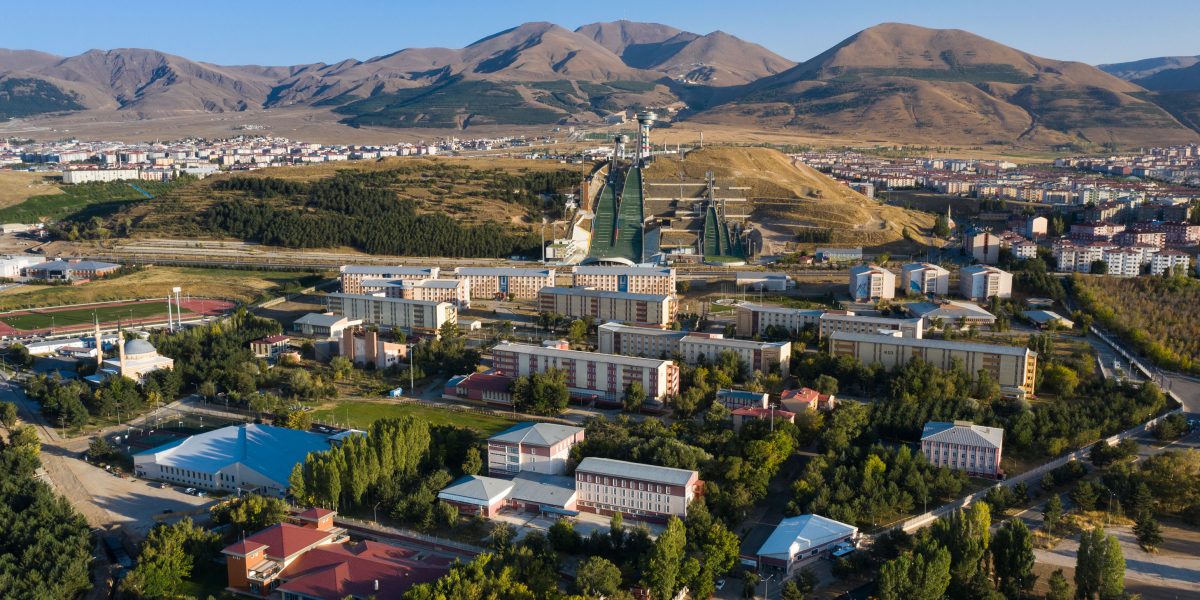
Atatürk University participates in structured, government-led planning and preparedness for climate-related disasters and cascading risks (e.g., extreme cold/snow events, floods, landslides, heatwaves, and major earthquakes whose impacts are intensified by climate change). The University’s role combines formal protocols with public authorities, regional climate-action planning, joint training and field exercises, and response coordination for displaced populations.
1) Formal protocol and governance with AFAD (Disaster & Emergency Management Presidency)
-
The University and the Erzurum Governorship’s Provincial AFAD Directorate signed a Disaster Awareness Education Cooperation Protocol, establishing a standing framework for joint education, preparedness, and risk-reduction activities on and beyond campus. The protocol text is publicly posted by the University. Atatürk Üniversitesi Atatürk Üniversitesi
-
Within Türkiye’s disaster management system, AFAD coordinates multi-agency emergency planning across specialist groups (search-and-rescue, CBRN, fire, planning, psychosocial services, etc.). The University’s protocol aligns its campus programmes and volunteers with this national structure for prevention, preparedness, response, and recovery. AFAD
2) Regional climate-action and risk planning with local government
-
Atatürk University is a named partner (with the Erzurum Governorship, Erzurum Metropolitan Municipality, and TEMA Foundation) in preparing the Erzurum Climate Action Plan. Work has included multi-stakeholder workshops, a draft plan, and public “citizen/volunteer” engagement—demonstrating shared planning with local authorities and community groups. Atatürk Üniversitesi Eskisite
-
The regional Sustainable Energy and Climate Action Plan materials for Erzurum explicitly recognize the University’s presence and capacity as a city asset in resilience planning, integrating campus–city linkages for climate risk reduction. Ejder3200
3) Preparedness training, field exercises, and early-action capacity
-
AFAD regularly conducts on-site earthquake and rescue trainings for University students and units (secure entry to collapsed structures, casualty extraction, safe exit), building campus-based human capacity that can be deployed under AFAD command during disasters. Atatürk Üniversitesi
-
The University’s Climate Change Coordination Office hosts webinars with the Regional Meteorology Directorate (WMO context), strengthening local early-warning literacy and hazard awareness for extreme weather. Atatürk Üniversitesi
4) Coordinated response and support for displaced populations
-
Following major disasters (e.g., the 6 February 2023 earthquakes affecting 11 provinces and displacing millions), the University organized coordinated aid mobilizations and psychosocial support teams, channeling assistance through AFAD and operating in full collaboration with state institutions—illustrating the University’s operational integration into government-led displacement response. Atatürk Üniversitesi Atatürk Üniversitesi
-
National and international situation reports document the scale of displacement after the 2023 earthquakes (millions homeless), framing the kind of multi-level response into which university partners like Atatürk University are integrated under AFAD’s lead. UNDP
5) Academic and technical contributions to disaster/climate planning
-
University researchers contribute to carbon management and sustainable energy planning for Erzurum (e.g., feasibility for solar/cogeneration, energy-efficient systems), which informs mitigation and adaptation measures in local plans and reduces cascading disaster risks. Ejder3200
-
Campus-based climate and disaster literacy (e.g., surveys on climate awareness; conferences hosted at Atatürk University on disaster management) supports community education that feeds back into municipal preparedness strategies. ResearchGate