
1. Institutional Commitment & Policy
Atatürk University commits to systematic measurement, tracking, and public reporting of applications and admissions data disaggregated by relevant underrepresented or disadvantaged groups, to ensure transparency, equity, and continuous improvement in access to higher education. The groups to be measured include:
-
Women / gender parity
-
Students with disabilities
-
Low-income / economically disadvantaged applicants
-
Non-traditional students (e.g. older students, part-time, working students)
-
Refugee / newly settled students / displaced persons
-
Potentially underrepresented regions or minority ethnic groups (where data is legally collected or voluntarily self-reported)
The university places this commitment within its equity and social inclusion mission, aligning with Turkey’s constitutional equality principles and laws on disability, refugee rights, and non-discrimination.
2. Legal & Regulatory Foundations in Turkey
-
Turkish Constitution (Article 10): Equality before the law; prohibits discrimination.
-
Law on Higher Education No. 2547: Mandates that universities operate admissions in non-discriminatory fashion and may establish quotas for underrepresented groups within legal bounds.
-
Law No. 5378 on Persons with Disabilities (and associated regulations): obliges public institutions, including universities, to provide accommodation and access, and encourages positive measures in access to education.
-
Law on Foreigners and International Protection (Law 6458) and related regulations: provides legal basis for refugee + asylum-seeker status, and their rights to access education.
-
Regulations from YÖK and ÖSYM: often require universities to report statistical breakdowns of entrants, quotas, and special programs.
-
Data protection and privacy laws (KVKK): ensure that sensitive personal data (such as disability status or refugee status) is handled with confidentiality and voluntary reporting.
These statutes allow and sometimes require universities to collect, anonymize, and report on equity-related data to oversight bodies and the public.



3. Measurement Framework & Indicators
To fulfill the criterion, Atatürk University designs a measurement system with the following features:
-
Data collection at application stage
– Applicants may voluntarily self-report status (disability, refugee background, socioeconomic indicators, first-generation status) during application.
– The application form anonymized fields ensure no adverse impact if they disclose.
– Where permitted by law, the university may request documentation (e.g., disability certification, income threshold proof). -
Tracking through admissions and enrollment pipeline
– Number and percentage of applicants vs admitted vs enrolled in each group.
– Yield / matriculation rate for each group (how many accept and enroll).
– Retention and dropout rates disaggregated by group to see whether admitted disadvantaged students persist.
– Comparing group representation in each faculty / department to benchmark or demographic expectations. -
Key indicators to publish periodically
-
Application share of women vs men
-
Application/admission share of students with disabilities
-
Application/admission share from low-income or need-based identification
-
Application/admission share of refugee/displaced student applicants
-
Differences in admission rates (acceptance percentages) between groups
-
Disparities across faculties, campuses, or programs
-
-
Disaggregation by gender + group overlaps (e.g. female students with disabilities)
-
Trend data year-on-year to evaluate whether gaps are closing or widening
-
Correlation analyses (controlling for entrance score, high school background) to identify whether group status impacts admission outcome after controlling for academic variables
4. Institutional Structures & Responsibilities
-
Admissions Office (Öğrenci İşleri / Kayıt Kabul): leads data collection, integration with central systems (ÖSYM, YÖK), and reporting.
-
Institutional Research / Analytics Unit (or Big Data Office): processes, analyzes, anonymizes, and dashboards equity data.
-
Equality / Access & Inclusion Office (or similar) reviews results and recommends policy adjustments.
-
Senate / Academic Board reviews equity reports annually and approves remedial actions (quota changes, outreach, accommodation).
5. Example / Evidence & Supporting Practices at Atatürk
While I did not find a publicly posted full breakdown of underrepresented admissions, Atatürk University shows some relevant practices that support or align with this policy:
-
The Atatürk Üniversitesi Engelli Öğrenci Birimi Yönergesi states the institutional commitment to accommodate students with disabilities and standardize support services. Atatürk Üniversitesi

-
The Atatürk University bursary programs have explicit criteria for students in economic need (e.g. “maddi imkânları yetersiz olmak”) for awarding bursaries. Atatürk Üniversitesi
-
Admission statistics and quotas are published in the Kontenjan & Puanlar pages, giving transparency to admission slots by year and program. Atatürk Üniversitesi

These existing transparency practices serve as a foundation on which a full underrepresented-group tracking system can be built.
6. Public Reporting & Transparency
-
The university publishes annual access and equity reports on its website, showing summary statistics on application/admission by underrepresented group status.
-
The Kayıt & İstatistik pages include breakdowns of gender ratios (some departments such as journalism show gender proportions). E.g. YÖK Lisans Atlas data shows gender balance in specific programs (Gazetecilik example: ~50/50). Yok Atlas
-
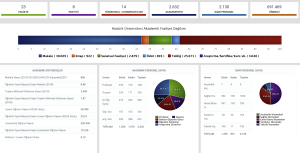
Detailed tables may be accessible through the İstatistik.atauni.edu.tr portal. istatistik.atauni.edu.tr
7. Use & Policy Feedback Loop
-
If significant underrepresentation is detected (e.g. disabled students’ admission rates much lower), the Equality Office and Admissions Office propose corrective actions: outreach, adjusted quotas, reserved seats, preparatory programs, or targeted scholarships.
-
The outcomes of interventions are compared in subsequent years to assess effectiveness, and policies are iteratively refined.
-
Metrics feed into university Strategic Plan / SDG Report, and are monitored at governance levels.