
Monitoring the Success and Graduation of Students from Low-Income Households at Atatürk University
SDG 1 – No Poverty | Indicator 1.3.2: Low-Income Student Success
Institutional Commitment
Atatürk University is committed to monitoring and improving the academic success and graduation outcomes of students from households within the lowest 20% of the national income distribution. The University recognises that equitable access to higher education must be accompanied by sustained academic progression and opportunities to complete degree programmes.
Its institutional approach focuses on identifying the educational outcomes of economically disadvantaged students, examining differences across academic units and using the findings to inform student support measures.
Monitoring Framework and Data Sources
The institutional monitoring framework described in the University’s previous sustainability submission covers three dimensions: admission, retention and graduation.
Monitoring is organised at faculty level to account for differences in programme structure, duration and academic requirements.
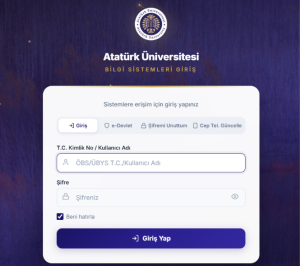
The University’s Student Information System (OBS) provides the administrative infrastructure for recording student enrolment, academic progression and graduation.
In May 2025, the University introduced an updated graduation application module within OBS. The system enables graduation procedures to be managed electronically, with academic and administrative approval stages.
The University’s Graduate Information System also uses graduation records from OBS, providing an additional institutional mechanism for maintaining graduate information.
These established information systems provide a documented administrative foundation for tracking student progression and completion.
Official sources:
- Student Information System – Technical Description
- Atatürk University Student Information System
- Graduate Information System
Identification of Students from the Lowest Income Quintile
For this indicator, the target population consists of students whose households fall within the lowest 20% of the national household income distribution.
The University’s previously reported monitoring methodology identifies economically disadvantaged students using household income information, scholarship records and student declarations.
The socioeconomic classification is intended to distinguish students experiencing financial disadvantage from the wider student population, allowing their educational outcomes to be monitored separately.
This distinction is necessary to determine whether students from low-income households successfully progress through their programmes and complete their studies.
Faculty-Level Retention and Graduation Monitoring
| Faculty | Low-Income Students (%) | Retention (%) | Graduation (%) |
|---|---|---|---|
| Education | 22 | 84 | 75 |
| Engineering | 17 | 77 | 65 |
| Medicine | 10 | 91 | 72 |
| Agriculture | 24 | 84 | 71 |
| Arts and Sciences | 17 | 82 | 66 |
| Economics and Administrative Sciences | 21 | 75 | 70 |
| Theology | 27 | 82 | 71 |
| Fine Arts | 17 | 78 | 65 |
| Dentistry | 10 | 86 | 70 |
| Veterinary Medicine | 21 | 77 | 68 |
| Reported University Average | 17.8 | 81 | 69 |
Reference: 2025 reporting
Faculty-Based Monitoring Results (2025)
In 2025, Atatürk University continued monitoring the academic progression and graduation outcomes of students from households within the lowest 20% of the national income distribution.
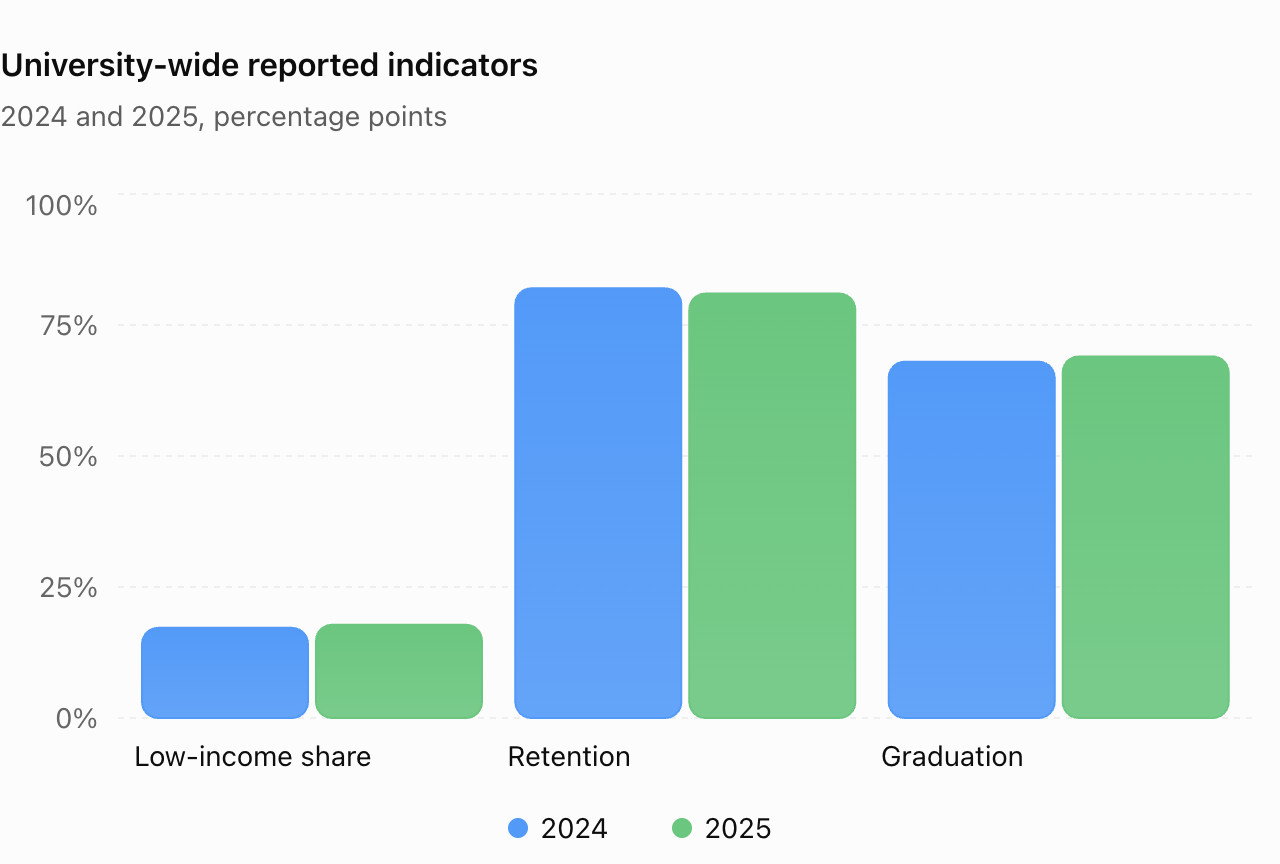
According to the University’s reported 2025 data, students from low-income households accounted for 17.8% of the total student population, while the reported university-wide retention and graduation rates for the monitored group were 81% and 69%, respectively.
Faculty-level results reveal differences in student outcomes. The Faculty of Education recorded the highest graduation rate (75%), followed by the Faculty of Medicine (72%). The Faculties of Engineering and Fine Arts recorded the lowest graduation rates (65%), identifying areas where further examination of academic and financial support needs may be appropriate.
The proportion of students from low-income households also varied across faculties, ranging from 10% in Medicine and Dentistry to 27% in Theology.
These findings provide a basis for monitoring educational disparities and identifying academic units where targeted support may be needed. The University uses its student information infrastructure to maintain enrolment and graduation records, supporting the continued assessment of educational outcomes among economically disadvantaged students.
Comparison with the Previous Reporting Year
Compared with the previously reported 2024 institutional figures, the 2025 results indicate:
- An increase in the proportion of low-income students from 17.2% to 17.8%.
- A decrease in the reported retention rate from 82% to 81%.
- An increase in the reported graduation rate from 68% to 69%.
These changes provide preliminary evidence of the direction of institutional performance. Their interpretation should take account of cohort composition, programme duration and the consistency of measurement methods between reporting years.
Graduation Measurement and Programme Duration
Graduation monitoring takes account of the different standard durations of degree programmes.
For example, undergraduate programmes in Engineering and Education generally follow four-year structures, while Medicine and Dentistry have longer prescribed durations.
The University’s monitoring approach therefore considers programme-specific completion periods when interpreting graduation outcomes.
For consistent cohort-based reporting, graduation rates can be expressed as:
Graduation Rate (%) = (Number of low-income students in an entry cohort who graduate within the defined observation period / Total number of low-income students in that entry cohort) × 100
Retention can be expressed as:
Retention Rate (%) = (Number of low-income students from an entry cohort who remain enrolled at the defined follow-up point / Total number of low-income students in that entry cohort) × 100
These definitions provide a transparent basis for interpreting the indicators, subject to confirmation that they match the University’s actual data extraction methodology.
Academic Progression and Institutional Graduation Procedures
Atatürk University maintains formal academic procedures for verifying whether students have satisfied the requirements of their degree programmes.
Graduation applications are processed through OBS, where relevant academic records and completion requirements are reviewed through established approval procedures.
The University’s published academic guidance describes electronic graduation applications, academic adviser review and subsequent administrative approval.
This system supports consistent documentation of graduation outcomes and the institutional availability of student completion records.
Official source: Atatürk University – Graduation Procedures
Student Support and Educational Continuity
The University provides several forms of assistance that may help students experiencing financial or academic difficulties remain enrolled.
These include meal scholarships for eligible students with low household income, formal part-time employment opportunities and access to psychological counselling.
The 2025 activity report of the Department of Health, Culture and Sports documents authorisation for part-time employment involving 350 students for nine months and 150 students for three months.
The report also records TRY 6,608,439.31 in gross payments associated with part-time student employment.
These programmes form part of the institutional support environment available to students. Although participation in them does not independently establish improved graduation rates, they provide practical mechanisms for addressing circumstances that may affect educational continuity.
Official source: Department of Health, Culture and Sports – 2025 Activity Report
Using Monitoring Results to Identify Educational Disparities
The purpose of monitoring graduation outcomes by socioeconomic background is to identify whether financial disadvantage is associated with differences in educational progression and completion.
Faculty-level monitoring allows the University to examine the outcomes of students from the lowest household income quintile within different academic contexts.
The historical dataset provides a basis for identifying faculties where lower retention or graduation rates warrant further investigation.
Where such differences are identified, the University can review the need for academic advising, financial assistance and other student support measures.
The effectiveness of these interventions should be assessed through subsequent monitoring of the same student groups.
Commitment to Continuous Monitoring
Atatürk University’s commitment to students from the lowest income quintile extends beyond initial enrolment to the monitoring of educational outcomes.
Its established student information infrastructure records progression and graduation, while the previously reported faculty-level monitoring framework provides a basis for examining the success of economically disadvantaged students.
By maintaining separate information on low-income student participation and completion, the University seeks to identify barriers to graduation and support students in completing their qualifications.
This approach is aligned with SDG 1 – No Poverty, particularly the objective of reducing the long-term effects of socioeconomic disadvantage through higher education.